





Bailey's Crossroad office complex project
Designed in 1935, Fallingwater is considered one of the world’s great architectural landmarks.The multi-cantilevered masterpiece seems to hover magically over a pristine stream and stunning waterfall in western Pennsylvania’s Laurel Highlands.
Owner
Charles E. Smith Company
Architect
Weihe Design Group, Washington,
Coatings Applicators
Universal Building Service,
Germantown, MD., John B.
onomos, Bridgeville, Pa.
Products
Corafion® ADS
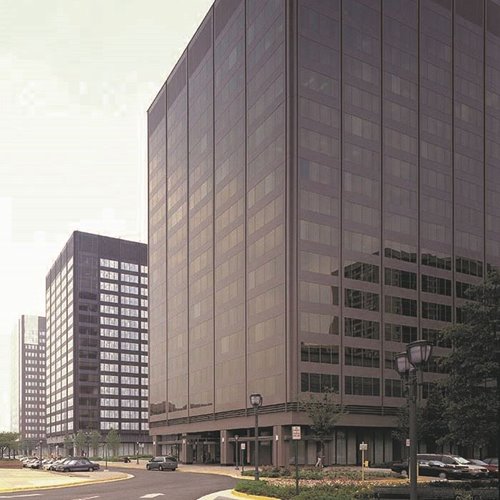
At Bailey’s Crossroad, near Arlington, Va., a three-building office complex known as the Skyline buildings had begun to shows its age. Erected in the 1970s, the trio of aluminum-clad, 15-story structures had dulled from a collection of sleek black towers into a strand of mud-colored eyesores.To clean up and contemporize the buildings, which had since been surrounded by neighborhood of gleaming new buildings, owner Charles E. Smith Co., of Washington, D.C., hired William Pegues, FCIC, of Weihe Design Group, a firm also located in the nation’s capital.
The Solar Chimney
After two years of work, and the application of a Coraflon® ADS, a revolutionary new field-applied coating system from PPG, the Skyline Towers look brand new. In fact, the renovation project was so successful that it became the subject of a feature article in the Journal of Architectural Coatings (April 2005).
In an interview with the magazine, architect Pegues summed up the problems posed by the Skyline Towers and the ultimate outcome desired by the building owners. “Here were three big obelisks of dark brown chocolate, very dated in the quality of the coating,” he explained. What the owners wanted was for the aging towers to complement the newer, more colorful buildings in the fast-growing area. “They wanted them to blend in, be a little more contemporary,” he said, instead of “standing on end like dominoes.”
To fulfill that mission, Pegues contacted his PPG Architect Representative who recommended the application of Coraflon ADS, a fluoropolymer resin-based coating that is field-applied but has the UV resistance, durability and extensive color selection associated with factory-applied coatings.
.jpg)

PPG Products
In fact, the durability of Coraflon ADS was one of the key selling points for the building owners and the architect, who wanted a long-term solution for maintaining the buildings’ appearance in place of the stop-gap painting projects that had sustained them through the 1990s. PPG was able to address their concerns by providing a 10-year “materials only” warranty that covered adhesion, color retention and chalk resistance.
During the course of the restoration project, more than 300 gallons of Coraflon ADS, custom-mixed to a tan-colored tint called “Beaver Creek,” were applied to the three buildings, covering approximately 450,000 square feet of surface area.
The work on Skyline One, the oldest of the three towers, began in 2001 with a hand-stripping and sanding assisted by an acetone solvent. Afterward, a conventional acid-based wash primer was applied by brush and roller, followed by a recoatable epoxy primer. Coraflon ADS was then applied with an air-assisted electrostatic spray. Work on Skyline Towers Two and Three was completed the following year, although stripping was not required for those buildings. In addition to expanding the durability, color options and renovation opportunities for older metal-clad buildings, Coraflon ADS also is a pioneering product in the area of environmental sustainability. All Coraflon ADS coatings comply with EPA rules governing the release of volatile organic compounds (VOCs) for architectural coatings and industrial maintenance, and the company is working on a newer formulation that will meet more stringent standards in the future.
A Smart, Cost-Effective Decision
In striving to create the greenest office tower in the world, PNC, Gensler and their partners constructed a building that was designed to surpass LEED Platinum certification, the U.S. Green Building Council’s highest rating.
In addition to a sophisticated double-skin façade that maximizes ventilation for heating and cooling and increases access to fresh air and natural light, The Tower at PNC Plaza operates highly-efficient water-based heating (radiant) panels and cooling (chilled beam) systems for supplemental heating and cooling.
Not only do these strategies enable The Tower at PNC Plaza to consume 50 percent less energy than benchmarks buildings of its size, but the high-rise also bathes more than 90 percent of its workspace in natural light.
Special thanks to the Journal of Architectural Coatings permitting the reprint of quotes and content from their April 2005 Project Profile on the Skyline Towers at Bailey’s Crossroads.
.jpg)